

Organising a conference in Saudi Arabia requires a predictable production process and local knowledge that keeps schedules, technical standards and stakeholder expectations aligned. Whether you are a multinational brand staging a product launch, a professional association running a regional forum, or an international organiser coordinating delegates from multiple time zones, understanding the mechanics of conference production in Saudi Arabia helps you budget, mitigate risk and set realistic timelines.
This article explains the conference production workstream and the key decision points buyers face in KSA. It covers live AV and staging coordination, speaker and content readiness, what to include in a practical production brief, and buyer checklists you can use when selecting a local partner.
The conference production workstream
Conference production is a sequence of interdependent workstreams rather than a single activity. The highest-performing events treat production as a layered project made up of technical delivery, content management, on-site logistics and guest experience. Below is a practical breakdown of the typical workstream and the buyer decisions that shape each phase.
- Initiation and scope definition (8–16 weeks out for regional events): Confirm objectives, target audience size, session formats (panels, keynotes, workshops), and preferred venues. Establish KPIs that matter to stakeholders: attendee capacity, live-stream reach, session cadence, brand requirements and available budget ranges. This phase produces a high-level production plan and a preliminary equipment list aligned with format choices.
- Venue selection and technical survey (6–12 weeks out): Conduct physical or virtual site surveys that check load-in access, power availability, ceiling rigging points, sightlines, room acoustics and back-of-house circulation. If the venue is in the Riyadh, Jeddah or NEOM corridors, also confirm local labour windows and any venue-specific contractor policies. Deliverable: an itemised technical rider and a site-risk register.
- Design and technical specification (6–10 weeks out): Convert the session plan into equipment lists for AV, lighting, staging, interpretation, recording and streaming. Decide stage size and layout, LED or projection options, and simultaneous interpretation requirements. This is where production and creative meet: branding placements, speaker lecterns and camera positions are finalised.
- Vendor procurement and crew scheduling (4–8 weeks out): Tender or shortlist suppliers for AV, staging, rigging, translation, local catering coordination, and temporary structures if needed. Confirm lead technicians, certified riggers and a stage manager. In KSA, verify that labour arrangements respect venue rules and local working-hour guidelines.
- Technical rehearsals and content freeze (2–5 days out): Run full run-throughs with speakers, AV cues and broadcast elements. Lock content files and show scripts at a clearly communicated cut-off time to prevent last-minute media changes from disrupting the run sheet. Deliverable: a final show-caller script and distributed cue sheets.
- Event delivery (D-day and multi-day operations): Execute load-in, technical checks, on-site rehearsals, front-of-house and back-of-house coordination, live streaming and post-session capture. Maintain a clear chain of command — stage manager, technical director and logistics lead — and use a central operations board for real-time updates.
- Close-out and handover (1–7 days after): Manage load-out, site restoration and asset reconciliation. Produce an operational debrief, equipment return reports and a lessons-learned summary for future conferences.
Buyer decision criteria during these stages include: venue familiarity and access windows, local health and safety practices, clarity of technical riders, depth of the local supply chain and contingency capacity for redundancy. For complex technical requirements, consider a single point of accountability for production to reduce coordination friction across multiple vendors.
AV, staging and show-flow coordination
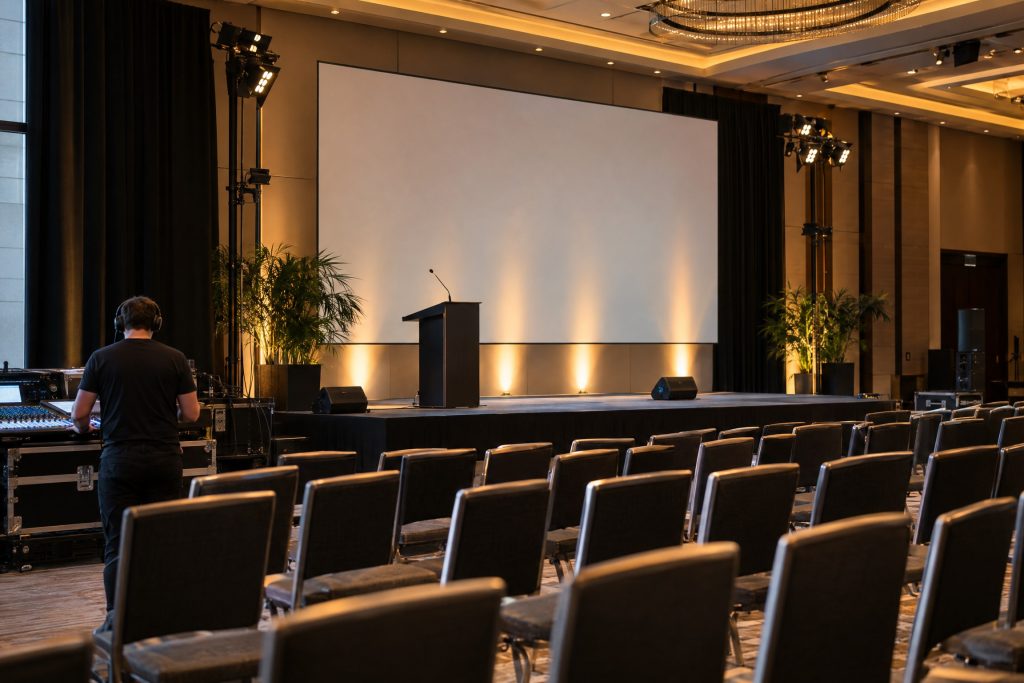
Audio-visual and staging choices create the attendee experience and simultaneously define production complexity. In Saudi Arabia’s venues, technical norms vary by city and venue class: conference centres in major cities often have integrated AV houses while hotels rely on external suppliers for larger set pieces. Planning for AV and staging involves aligning performance expectations with technical practicality and budget.
Key technical components to specify early:
- Audio: Room size determines speaker arrays and mixing capacity. Confirm whether the venue supplies in-house sound and whether production requires a dedicated FOH engineer, monitor mixer for presenters and wireless microphone inventory.
- Visual: Decide between LED walls and projection. LED provides higher brightness and consistent colour for wide audiences; projection can be more cost-efficient for small rooms. Specify input counts, camera feeds and a content playback system.
- Lighting and rigging: A stage wash, key lights and front-of-house house lights require a rigging plan that considers power and ceiling access. Plan for dynamic lighting cues for session transitions and keynote moments.
- Broadcast and streaming: Identify bitrates, encoder locations and redundancy (backup encoders, separate internet routes). Confirm latency tolerances if remote speakers are joining live from abroad.
- Staging and sightlines: Stage format selection (proscenium, open stage, theatre-in-the-round) should be informed by audience capacity and camera positions. Include multiple camera angles and walkways for moderators.
- Interpretation and accessibility: For multilingual conferences provide booths or wireless interpretation systems and plan audio feeds for live captions or assistive listening devices.
Operationally, show-flow coordination demands a single, consolidated run sheet. A good run sheet contains call times for all crew and talent, cue lists, package durations, mic assignments and camera shots. Technology can help: digital cueing tools and real-time scheduling platforms reduce human error in cue calls. For specific technical production and AV requirements see the technical production and AV services page for service descriptions and examples.
Redundancy planning is non-negotiable. Typical buyer choices include parallel encoders for streaming, backup audio paths, spare microphones and secondary projector inputs. Also plan the physical flow of set elements: load-in doors, freight elevators and on-site storage. For complex builds, allocate at least one clear day for virtual or physical tech rehearsals before delegates arrive.
Speaker, content and venue readiness
Speakers are the centrepiece of most conferences; content readiness is where many productions succeed or fail. Venue readiness is equally critical: a technically precise plan is ineffective if the venue cannot support load-in, has power limitations, or restricts installation windows. This section outlines speaker prep, content management and venue readiness steps to minimise last-minute risk.
Speaker and content readiness checklist:
- Content submission deadlines: Issue a clear deadline for final slide decks, video packages and any incoming AV files. Specify formats, aspect ratios and resolution. Lock content at least 72 hours before event start for a multi-room conference; for broadcasted keynotes consider an earlier freeze.
- Speaker briefings and rehearsals: Schedule at least one mandatory technical rehearsal for each presenter. Use rehearsals to test microphones, screen transitions and presenter confidence with stage lighting. Provide presenters with a one-page technical brief covering walk-on timing, clip playback triggers and mic etiquette.
- Media and playback validation: Test video codecs and file integrity on the final playback server. Transcode on-site if necessary and maintain versions on redundant drives. Store final files in a cloud location with controlled access for last-minute retrieval.
- Transporting equipment and media: Track all media assets and camera cards. Use manifested crates and an on-site asset custodian to sign equipment in and out.
- Venue technical compliance: Verify power capacity for lighting and rigging plans. Confirm the availability of quiet and secure green rooms, adequate Wi-Fi and separate internet routing for production use. If the venue cannot provide necessary infrastructure, include temporary solutions in logistics planning.
For international companies, cultural and operational considerations are important. Respect local schedules and prayer times in the event timetable, and confirm dress codes and access protocols tailored to private or government-owned venues. When planning hospitality and guest flow, align arrival, registration and breakout sessions so guests experience consistent transitions between speakers and networking sessions.
Speaker management tools that integrate with your production system reduce friction: centralised portals for speaker bios, slide upload, rehearsal times and travel documentation allow the production team to coordinate arrivals and technical checks efficiently. Consider a dedicated speaker liaison to handle last-minute requests and to escort keynotes through tech rehearsals and stage call.
What to include in a conference production brief
A concise production brief is the practical contract between an organiser and the production team. It should be complete enough to allow accurate scoping and costing, and flexible enough to accommodate creative changes. Below is a structure you can use as a template when creating a brief for a conference production in Saudi Arabia.
Production brief template and buyer checklist:
- Event overview (one paragraph): Purpose, target audience, expected headcount, event dates, and primary success metrics.
- Venue details: Name and address, room names with capacities, contact details for venue technical manager, load-in instructions, and any venue constraints (e.g., no drilling, limited rigging points).
- Session schedule: Full timetable including session lengths, concurrent rooms, breaks and networking periods. Attach a draft run sheet with provisional speaker names and scheduled arrival/rehearsal times.
- Technical requirements: Audio: PA type, mic counts, interpreters. Visual: LED wall or projection size, stage screen size and aspect ratio, playback codec requirements. Broadcast: number of camera feeds, streaming destinations, bitrate requirements and captioning needs.
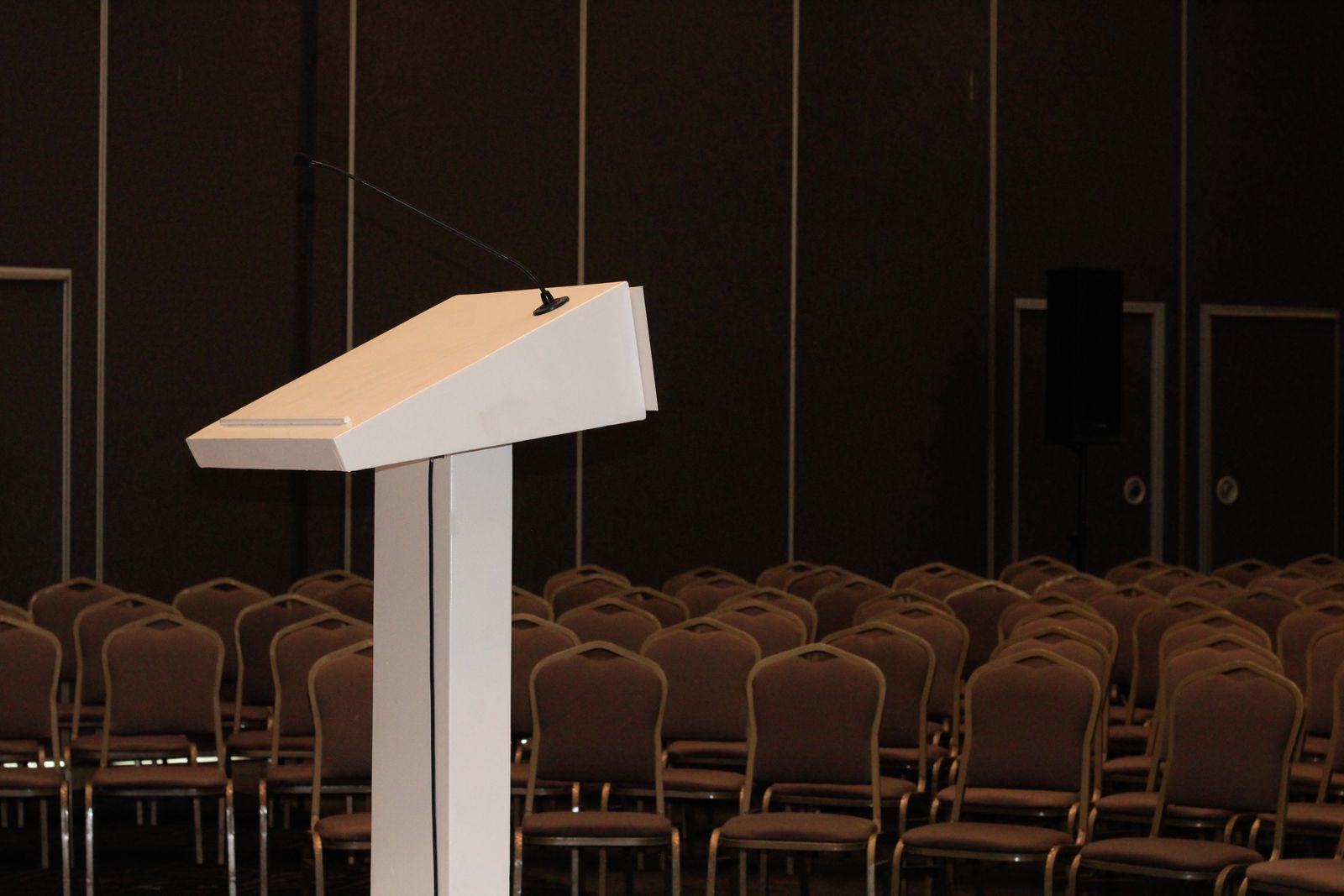
- Stage and set: Stage size and layout, flooring and carpeting needs, lecterns, podium branding and furniture requirements for panels. Include load-bearing and rigging notes where applicable.
- Audience experience: Registration flow, badge types, seating layouts (theatre, classroom, cabaret), ushers, signage and VIP handling.
- Security and access control: Access lists for crew, backstage areas, and VIP zones; CCTV considerations if needed; coordination with venue security.
- Operational teams: Contacts for production manager, technical director, stage manager, logistics lead, hospitality manager and an onsite client liaison. Confirm who will be the decision-maker for scope changes on site.
- Health, safety and permits: Note that requirements vary by event scope and stakeholders; identify permit owners (venue, municipal authority, temporary structure vendor) and list any known permit applications that must be triggered.
- Mobility and accessibility: Plan accessible seating, assistive listening devices and ramps where needed.
- Budget envelope and procurement rules: Provide an indicative budget range, procurement deadlines and approved vendor lists if procurement must go through local public tender processes.
- Close-out expectations: Asset return timelines, debris removal responsibilities and post-event deliverables such as raw recordings and an operations debrief.
Decision criteria for procurement can be embedded in the brief as evaluation rubrics. Example criteria for AV suppliers: technical capability and redundancy plan (30%), relevant experience in similar-sized KSA venues (25%), crew certification and safety processes (20%), price (15%) and response times for technical emergencies (10%). When comparing staging suppliers, weigh build time and load-in logistics equally with materials, safety records and local labour availability.
If you require an integrated logistics and site plan, a local partner can produce an itemised site logistics schedule including manpower manifests, traffic management plans, freight arrival slots and timing for furniture and catering deliveries. For logistics-based scope and site setup needs, see the logistics and site setup services page to understand typical planning packages and timelines.
Implementation steps and practical buyer checklists
Below are sequential implementation steps and checklists you can use as a ready reference when preparing to contract a production partner in Saudi Arabia.
90–60 days before the event:
- Confirm objectives, audience size and session formats.
- Complete venue technical survey and obtain venue technical rules.
- Issue a production brief to shortlisted suppliers and request detailed technical proposals.
- Establish the main point of contact for production and the change-order sign-off authority.
60–30 days before the event:
- Finalize AV and staging technical specifications and approve CADs or site plans.
- Confirm interpreter, broadcast and streaming providers and test connection paths for remote presenters.
- Circulate speaker deadlines and user guides for content submission.
- Lock logistics windows for load-in/load-out and submit permit trigger lists (if any) to stakeholders.
30–7 days before the event:
- Run content validation and media checks; transcode final files if needed.
- Schedule and confirm rehearsal times for all presenters and technical crews.
- Order and label consumables (batteries, cables, adapters) and prepare spare equipment kits.
- Conduct pre-event walkthroughs with venue, production, security and caterers.
7–0 days before the event:
- Load-in and install staging, lighting and AV systems according to the agreed site plan.
- Execute full technical rehearsals with camera blocking and talent cues.
- Distribute final run sheets, contact lists and emergency escalation plans to all leads.
- Confirm streaming routes, encoder redundancy and remote presenter connectivity.
Day(s) of event:
- Maintain a central stage manager and operations board for cueing and incident management.
- Log all cue changes and unexpected scope changes for later reconciliation.
- Provide a dedicated liaison for VIPs and speakers to manage timing and arrival.
Post-event:
- Conduct a site restoration checklist and reconcile any venue damages or missing assets.
- Complete an after-action report capturing operational metrics, incidents and improvement actions.
- Arrange return logistics for rented equipment and confirm vendor invoices against delivery records.
Worked planning example: applying the brief
Consider a conference with live presentations, a remote speaker and an audience question session. This is a hypothetical planning exercise, not a description of a Smart Events project or a promised result. Its purpose is to show how the guidance on conference production becomes a set of decisions that teams can actually use. The critical dependency is that tested audio routing between the room system, remote platform and recording feed. Establish this before treating the programme as confirmed. A useful discussion asks what must be true before the next activity starts, who can verify it, and what the team should do if that condition is not met.
Make acceptance observable
Use a signed rehearsal checklist and a labelled cue sheet as the starting point for acceptance. The owner of each deliverable should explain what another team will receive and how it will be checked. Avoid descriptions such as “fully ready” when different suppliers interpret readiness differently. Agree the inspection location, the information needed and the person authorised to accept the handover. Record limitations as well as completed work. If a condition cannot yet be verified, keep it open in the action log instead of presenting an assumption as a finished task.
Frequently Asked Questions
What is included in the agreed scope?
conference production in Saudi Arabia covers all technical and logistical activities required to stage a conference in the Saudi market. Typical inclusions are technical design (AV, lighting, staging and rigging), live production crew, content playback and broadcast/streaming setup, stage management, on-site logistics coordination, interpretation services where required, and close-out activities such as load-out and site restoration. Production scope can be delivered as an integrated package or as modular services depending on the organiser’s needs.
How early should planning begin?
Lead times depend on scale and complexity. For small to medium conferences, begin planning 8–12 weeks ahead. For larger or technically complex events, especially those requiring temporary structures, international broadcast, or multiple concurrent rooms, plan 4–6 months in advance. Allow extra weeks if permits, specialized rigging, or international freight logistics are required. Early engagement with local production partners reduces last-minute risks and helps confirm realistic timelines.
What should an international organiser include in the brief?
A production brief should include event objectives, venue details and constraints, detailed session schedules, technical requirements for audio, visual and lighting, broadcast/streaming needs, stage and furniture specifications, speaker and content submission deadlines, access and security requirements, budget envelope and decision authorities, and post-event close-out expectations. Also include any cultural or regulatory sensitivities and note that permit and compliance requirements vary by event scope and local authorities.
How can a local event partner help?
A local partner brings market knowledge, vendor relationships, and on-the-ground logistics capability. They can manage venue coordination, secure local labour and technicians, prepare site logistics and traffic plans, adapt technical designs to local infrastructure, and provide an on-site operations team. A partner with digital operations tools can also streamline communication between production, logistics and front-of-house teams. When choosing a partner, evaluate their local presence, operational transparency and their approach to contingency planning.
Connect this plan to the right delivery services
Event Production & Technical Services and Catering & VIP Hospitality can be discussed together with Smart Events. Share the venue, event date, audience, operating hours and the tasks you want included. Ask for a written scope that identifies the responsible lead, deliverables, exclusions and approval points. Service availability, staffing, specialist partners and final pricing should be confirmed for the specific project rather than assumed from a general guide.